
-
ACTION CENTRE
-
NEWS AND EVENTS
-
WHO WE ARE
- Online Shop
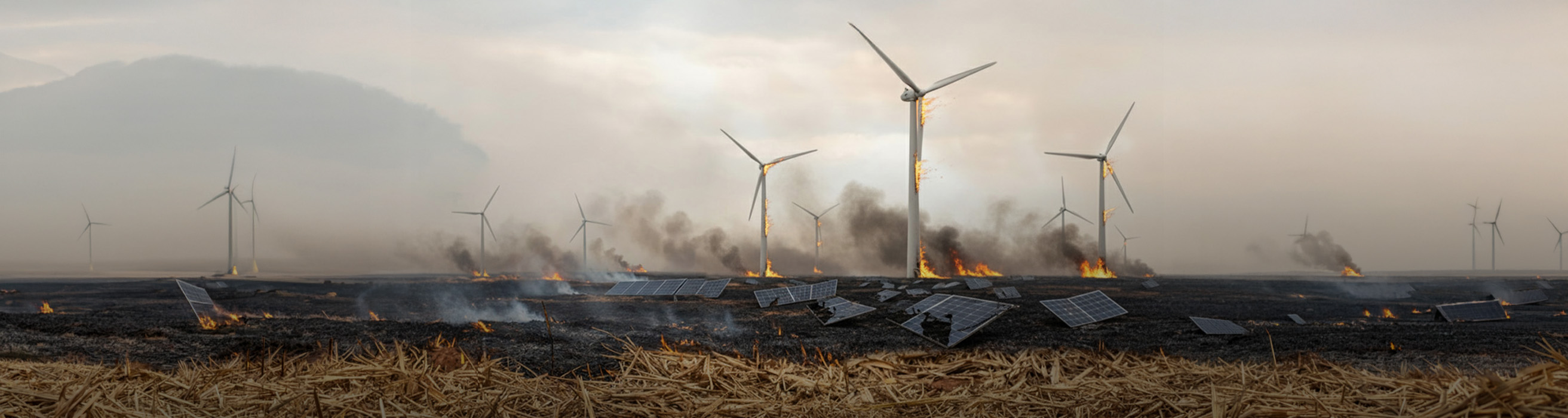
The real impacts of ‘net zero’
ONE NATION ENERGY POLICY: ENDING ‘NET ZERO’ AND BUILDING ENERGY SECURITY FOR ALL AUSTRALIANS
The real impacts of ‘net zero’ are:
- primarily, a massive increase in the cost of Australian electricity – at least 206% since the first introduction of large-scale renewable energy targets by the Howard Coalition Government in 2001; in some states the figure is closer to 300%;
- the cost to Australian taxpayers of the ‘renewable energy transition’ (the chief vehicle by which proponents claim ‘net zero’ will be achieved by 2050), estimated at $1.5 trillion;
- the massive geographic footprint and high materials and energy intensity required by renewable energy generation (including wind turbines, solar facilities, batteries and new transmission lines), particularly impacting productive agricultural land, native forests and ocean habitats; and
- increasing vulnerability of Australian energy grids to weather or system shocks, examples of which include the statewide blackout in South Australia in September 2016 and the nationwide blackouts in Spain and Portugal in April 2025.
The impact of record high electricity prices on Australian households, business and industry has been devastating.
Outside of Europe, Australia has the highest average household electricity prices in the world at US$0.246/kWh (2024). This is substantially higher than other Western nations rich in natural energy resources such as the United States (US$0.179/kWh) and Norway (US$0.157/kWh), and more than twice as high as Canada’s average price (US$0.118/kWh). Household energy costs in Australia have increased by up to 40% in just the past two years to June 2025 under the pro-‘net zero’ Albanese Labor Government.
In December 2024 the Australian Energy Regulator (AER) revealed more than 130,000 Australian households were on energy hardship plans in 2024, up from fewer than 96,000 in 2023. The AER also revealed that more than 215,000 Australians are in energy debt, with average household energy debt in 2025 at $1415 (up $309 from the previous year).
In June 2025 Energy Consumers Australia reported that 19% of Australian households were experiencing, or vulnerable to, energy hardship.
Small businesses across many industries, particularly in the food sector (farmers and irrigators, processors, distributors, grocers), have reported energy price increases of more than 50% since the election of the Albanese Labor Government in May 2022. The Council of Small Business Organisations Australia (COSBOA) reported in March 2024 that:
- 34% of small businesses experienced financial strain and hardship paying their energy bills;
- 20% of small businesses were struggling to pay their energy bills on time; and
- 45% of small businesses were concerned about their ability to pay future energy bills.
In March 2023, the Australian Small Business and Family Enterprise Ombudsman submitted that volatility of electricity and gas prices constrained and discouraged business investment, and these key inputs were nominated by almost half of surveyed small and medium enterprises as the highest pressure they faced. The Ombudsman stated: “Persistently high energy costs also diminish business profit margins through lower sales revenue, as rising household costs reduce consumer disposable income.”
‘Net zero’ is killing manufacturing in Australia. According to the Australian Bureau of Statistics (ABS), manufacturing as a percentage of Australia’s gross domestic product (GDP) has fallen from 8.9% to 5.1% since 2005. Australia now has the smallest manufacturing share of GDP in the OECD. ABS figures also show manufacturing electricity costs in Australia have risen 181% since 2000, and natural gas costs have risen 186%. Australian Securities and Investments Commission (ASIC) data has shown that more than 1400 Australian manufacturers have become insolvent since 2022-23.
Compounding the impact of ‘net zero’ on industry is the virtual tripling of domestic gas prices since the start of large-scale LNG exports from the Australian east coast. This has helped to create an artificial shortage, perversely leading to Australia (one of the largest LNG exporters in the world) having to import LNG into New South Wales and Victoria (and possibly South Australia).
‘Net zero’ is also extremely harmful to another key economic sector: agriculture. Electricity is a major agricultural input costs, particularly for dairy farming (which requires power for milk sheds and on-farm refrigeration) and irrigation (requiring on-call power for pumping and pressurising water). Food processors also use large amounts of electricity: a significant employer in regional South Australia, Nippy’s, had its electricity costs double in one year (to August 2024). The urea fertiliser industry – an absolute necessity for food production utilising Australia’s highly variable soils – has also been driven offshore by high energy costs, forcing farmers to import them at greater cost.
In addition, many farmers are facing the forced installation of high-voltage transmission lines on their properties as part of the ‘renewable energy transition’. These represent an additional fire hazard, but even more importantly – as demonstrated by recent laws introduced in Victoria by the Allen Labor government – an unacceptable intrusion on farmers’ private property rights.
The case for ending ‘net zero’ is strong based on the impacts and false justifications alone, however it is also imperative to dismantle the policy for what it truly is: a vehicle for creating a socialist Australia in which citizens are forced under comprehensive government control. Rising electricity prices under net-zero policies contribute to energy poverty and enable increased centralised government control over the economy. The essence of individual freedom requires the constant monitoring and curtailment of the power and growth of the state, or as Thomas Jefferson said, “eternal vigilance”.
This is part of a global movement which aims to use the excuse of reducing emissions as a way of restricting and controlling people’s movement, diets, employment, housing, education and purchases. It’s epitomised by the World Economic Forum’s so-called ‘Great Reset Initiative’ project launched in 2020, ostensibly aimed at rebuilding economies following the COVID-19 pandemic utilising environmental, social and governance metrics and the infamous quote attributed to (former) WEF chairman Klaus Schwab: “You’ll own nothing and be happy.”
In many respects it’s already occurring, for example the ‘electrification’ policies of some state Labor governments banning the use of gas appliances, and the Albanese Labor Government’s National Electric Vehicle Strategy and ‘Build to Rent’ tax reform package. Another example is the New South Wales government’s Greater Sydney Region Plan A Metropolis of Three Cities, which aims to create so-called ‘30-minute cities’ in which Sydney residents will all live within 30 minutes’ of their shops, employment, schools and all other services they require so they will not travel outside of their immediate area without penalties or prohibitive costs.
One Nation has always opposed socialism as an anti-human economic and political system that is imposed rather than freely chosen, that restricts or eliminates basic human rights and freedoms, that impoverishes nations and has comprehensively failed in every country that has attempted it. It is also one of the main reasons we oppose ‘net zero’.
‘Net zero’ is destroying Australia
Lowering prices for households, businesses and industries
Do you like this page?